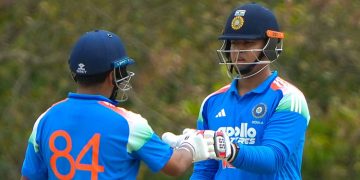
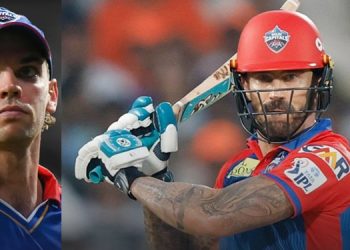
Free hit in Cricket is a unique rule as it punishes the bowler and fielder side for breaking the law by awarding the batsman. Its common life equivalent is that your parents give your sibling chocolate each time you break a house rule. So, a free hit not only punishes you but also boost your opposition directly.
Free hit is a modern-day rule and has a significant impact on the game ever since. The rule has changed frequently, which has caused lots of confusion. So, we would be discussing free hit rules in details.
What is a Free Hit in Cricket?
If a bowler bowls a no-ball, then the umpire rewards the batting side a free hit. So, on the next ball, the batsman is free to swing his bat as hard as possible to get maximum runs. This is because batsmen can’t be out due to regular dismissal.
The free hit ball out rules says that a batsman won’t be out due to common dismissal like being caught, bowled, or leg before wicket (LBW). A batsman would be out on a free hit only if he is run out, obstructing the field and hitting the ball twice.
Thus, free hit in Cricket is a curse to bowlers, and no one dares to bowl a no-ball. Many important games have been won, and tournaments have been decided by free hit since its introduction.
First Introduced:
Batsmen were complaining for a long time about bowlers bowling no-ball and asking for a rule change. There were many suggestions on how to penalize the bowler. However, none were introduced until T20 came along.
Free hit is a byproduct of T20 and was initially introduced in T20 and later in ODI in the same year since the abandoned ODI between India and Australia in Bangalore. Since its introduction, Cricket Free hit is regular among fans around the globe.
However, free hit in test cricket is not introduced. It looks like no-one is interested in making changes in free hit rules for test cricket. For now, you can enjoy free hit only in Limited overs cricket.
Free Hit Rules in Limited-overs Cricket:
ICC has defined Free hit rules as per the Law 21 of ICC playing conditions for limited-overs cricket. The delivery following a no-ball is declared a free hit by the on-field umpires. ICC also specified that the rule applied to all different types of no-ball.
- Thus, a no-ball can be awarded in limited-overs cricket if the bowler
- Oversteps his front foot,
- Bowls a waist-high ball,
- Throws the ball,
- Changes the bowling side without notifying the umpire,
- Doesn’t have minimum fielder insider the 30-yard circle, etc.
Sometimes, the bowler might bowl a wide or another no-ball on the free hit. In such a case, the subsequent delivery is also a free hit. Thus, there is no escaping for the bowler. He needs to bowl the free hit to complete all his legal delivery in his over. There have been many instances where bowlers have bowled continuous free hit delivers.
Are Field Changes allowed on a Free Hit?
Let’s imagine batsman A is batting, and the bowler bowls a no-ball. If he is able to take a run and give the strike to batsman B. Now, the bowling side is allowed to make fielding changes on a free hit. However, if Batsman A is still facing the free hit, then the field side can’t make field changes. They can’t even exchange the fielder’s position. Any change in the field will result in another no ball or a free hit.
However, there is a catch here. If the no-ball was called due to fielding transgression, such as having fewer fielders inside the 30-yard circle. Then, the fielding side is allowed to make fielding changes irrespective of who is facing the free hit delivery. The fielding captain now must only change the error in the fielding position.
Some of you might be feeling bad for the bowler. As Cricket Free hit is lit, unfortunately for the bowler. But they have a few tricks up his sleeves. For starters, they can change the side of his bowling. According to their preference, they can also change the mode of bowling, i.e., switch to spin or fast bowling. The bowler must inform the umpires of change, or another no-ball will be called.
Free Hit is unfortunate for the bowlers. The only respite they have is that they can change the mode of bowling for the free hit delivery. This means they can change the sides or switch to bowling pace instead of spin and vice versa. The bowlers must inform the umpires of this change, or it will be another no-ball.
Free Hit Rules Changes Over Time
There have been a few changes to free hit rules over time. Initially, if a bowler oversteps his front foot, the umpire would signal a no-ball.
Then, later that year, ICC released a clarification in October 2007. It stated that the Free Hit would apply to the next delivery after a bowler oversteps his front foot or if the back foot cuts the return crease or lands outside of it.
This changed rule was introduced in ODIs in 2007. This created confusion initially, as many players thought they would receive a free hit if there is a no-ball.
In 2015, the ICC made another change to Free hit rules. They stated a Free Hit would be awarded for any kind of no-ball. So, a beamer, fielding restriction will also result in a free hit. This is particularly hard on the bowlers as they might be penalized for someone’s else mistake. Currently, there have not been any changes to the free hit rule by the ICC after 2015.
The only major development in Free hit is the third umpire looks over the front foot instead of on-field umpires. This has improved a lot of decision as the third umpire has the time to make the right call.
Final Conclusion
Free Hit is a modern phenomenon in Cricket. It is clearly introduced to make the limited over version lots more exciting for the fans and batsmen. Many people have accused the rule to be in favour of batman and penalize bowlers too harshly. This is because batman swings his bat on a free hit delivery and gets maximum easily.
However, from a neutral point, a Free hit in cricket is quite fair. Many bowlers used beamer to scare the batsman, and they got away with it cheaply. Also, the bowlers get a psychological advantage if they don’t allow the batsman to score off a free hit delivery.
In a nutshell, Free hit in Cricket is a rule, and both sides need to follow it. Plus, a bowler doesn’t have to bowl a free hit delivery if he bowls a no-ball. So, it is in the bowler’s hand at the end of the day.